
How PIVOT and Vine Middle Are Using AI to Improve Access to Grade Level Learning
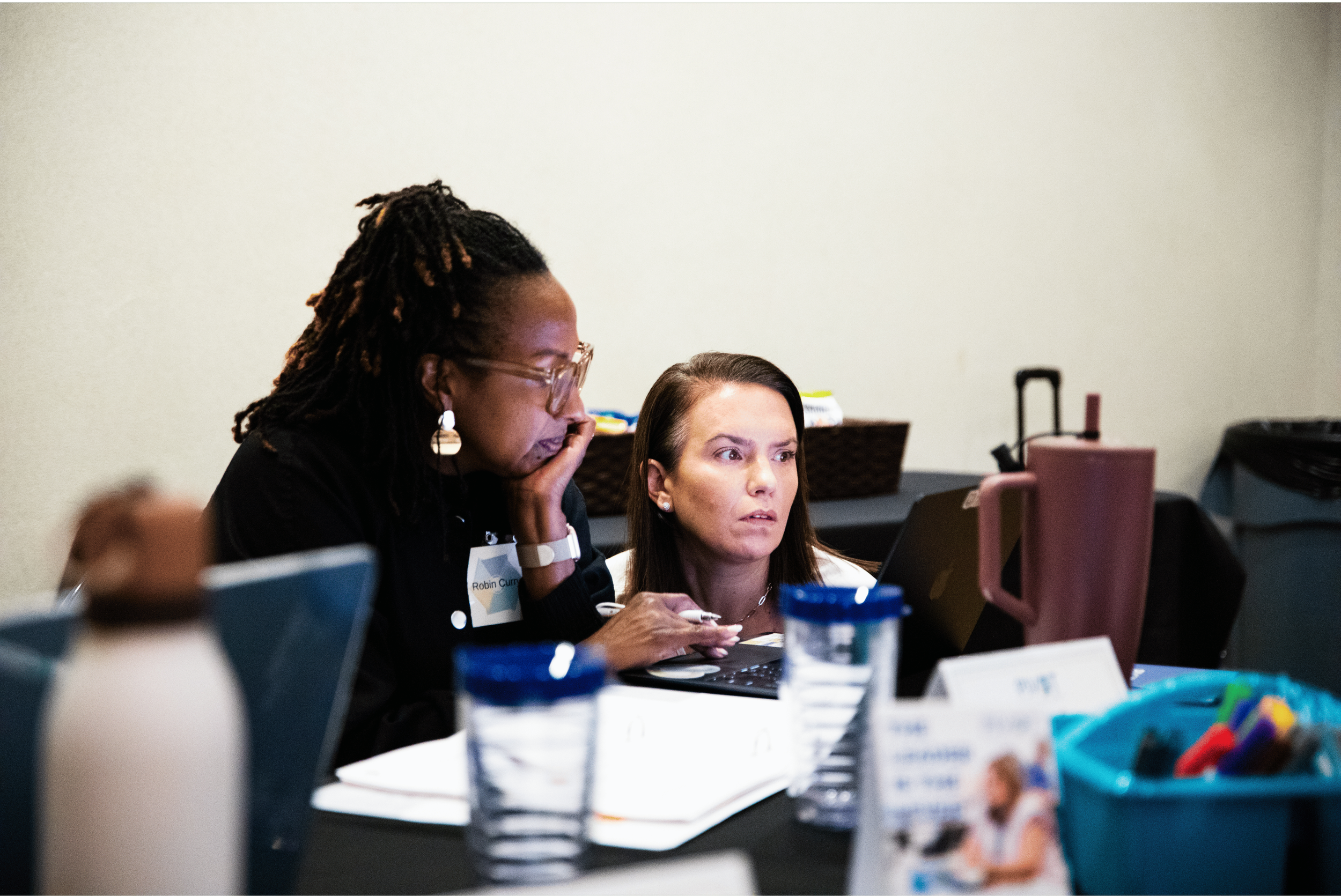
Robin Curry, principal of Vine Middle Magnet School, and Amy Galloway, CEO of PIVOT: School Improvement Leaders, collaborate during a PIVOT Learning session.
A student can follow the ideas in a grade-level text and still get stuck while reading a word like environmental. A student can understand a math task and still lose minutes working out 7 × 8. Those small stalls add up, and they impact the way capable students sustain independent engagement with grade-level work.
At Vine Middle Magnet School in Knoxville, educators are implementing strong HQIM in ELA and math and are committed to helping students engage deeply with rigorous content. Like many middle schools, Vine is exploring how to strengthen foundational reading and math skills within Tier I instruction so students can participate even more confidently and independently.
This year, Vine is partnering with PIVOT to take a step forward — work made possible through support from the SCORE AI Innovation Fund, which is investing in responsible, student-centered uses of artificial intelligence across Tennessee. With SCORE’s catalytic grant, PIVOT is designing, and Vine is piloting, an AI tool that embeds foundational skill development directly into daily instruction. Importantly, this work does not place students in front of a computer or deliver AI-led lessons. Every routine is taught by the teacher, in the classroom, as part of the existing HQIM lesson. It’s not an intervention add-on. It’s not a separate program. It’s a coherent, integrated feature of the lessons students already experience.
The Challenge: Strengthening Access to Grade Level Work
Vine’s educators are deeply committed to delivering high-quality instruction every day. They also recognize a familiar challenge across middle grades classrooms: HQIM materials are rigorous and well designed, but they provide limited explicit support for older students who benefit from structured practice in decoding, morphology, fluency, and number sense.
Teachers see opportunities to deepen access:
Grade-level texts often include multisyllabic words and complex vocabulary that benefit from quick, explicit practice.
Math tasks require fluency with operations and fractions, yet HQIM materials typically include only a few practice problems.
Foundational routines are powerful, but designing them daily—aligned to HQIM—requires time and specialized knowledge.
These are not student deficits. They are instructional design challenges that exist in nearly every middle school implementing rigorous materials.
Vine’s educators know exactly what would strengthen access. They simply need a tool that makes it feasible.
The Innovation: PIVOT’s AI-Powered Foundational Routine Generator
With support from SCORE’s AI Innovation Fund, PIVOT is leading the design and development of a new AI tool that sits on top of Vine’s existing HQIM in ELA and math. The tool is intentionally simple. It does not replace HQIM. It does not make instructional decisions. It does not teach students. Teachers lead every part of the routine. The AI simply prepares the materials. The instruction remains fully human-led.
Instead, it automates the part of planning that teachers do not have time to do every day.
Here’s what PIVOT’s tool does:
Generates a 10-minute foundational skills routine aligned to that day’s HQIM lesson.
○ ELA: syllable types, morpheme study, and decoding practice using words from the actual text.
○ Math: targeted fluency practice with enough repetition to build automaticity.
Delivers a ready-to-use routine teachers can implement immediately. Teachers deliver the routine aloud, guide practice, and respond to student thinking. The AI never interacts with students.
Builds coherence across Tier I and intervention. Foundational skill development happens inside the lesson, not only in Tier 2 or Tier 3 settings.
This is not AI for AI’s sake. It is AI used to solve a very human problem: teachers cannot do everything, and students deserve instruction that meets them where they are.
Why This Matters: A Model for Instructional Coherence
The work at Vine is more than a pilot; it’s a proof point for what’s possible when AI is used responsibly and purposefully in schools.
PIVOT’s approach strengthens Tier I instruction. Students practice decoding, morphology, and fluency in the context of the grade-level work they are already doing.
It reduces teacher planning load. Teachers gain a daily companion that handles the most time-consuming part of foundational planning.
It increases access. Students who benefit from more explicit practice—multilingual learners, students with disabilities, and students navigating economic barriers—receive consistent, aligned support without being pulled from class.
It builds coherence across the system. Tier I, intervention, and assessment reinforce one another instead of operating in silos. This aligns with Knox County’s broader work to strengthen coherence across instructional tiers.
It reflects SCORE’s commitment to responsible, instruction-aligned AI. SCORE’s AI Innovation Fund is supporting projects that help educators use AI to enhance—not replace—high-quality teaching and learning. Vine and PIVOT’s work is one of those models.
The Vision: Strengthening Access and Instructional Confidence
Vine has demonstrated meaningful growth in recent years. The next step is ensuring students experience even greater access to grade-level texts and tasks.
By embedding decoding, morphology, and fluency practice into daily instruction, PIVOT and Vine aim to:
Strengthen students’ independent engagement with grade-level materials
Reduce reliance on teacher read-alouds
Support more confident problem solving in math
Increase instructional precision and coherence
Enhance student engagement by making grade-level work feel accessible—not overwhelming
Create a scalable model for how AI can support teachers.
A Future Where AI Helps Teachers Do What They Do Best
The AI work at Vine is about giving educators the tools they need to deliver coherent, high-quality instruction every single day—without sacrificing rigor, without lowering expectations, and without burning out.
It is about ensuring that every student experiences instruction that feels accessible, connected, and empowering.
And it is about proving that when AI is used thoughtfully, ethically, and purposefully, it can be a powerful engine for improvement.
This work is possible because of support from SCORE’s AI Innovation Fund. PIVOT is leading the design. Vine is showing what this looks like in practice.
Together, they are building a model that can help schools deepen access to grade-level learning in a way that is sustainable, teacher-centered, and grounded in strong instructional materials.
Explore The Work:
For more on PIVOT and Vine Middle Magnet School’s AI pilot and the SCORE AI Innovation Fund, explore the coverage and resources below: