
From Curiosity to Governance: What School Leaders Learned in Our AI-Ready Leadership Series
Artificial intelligence is already moving through schools faster than most systems can formally respond. Teachers are experimenting with it. Students are using it. Families are asking questions. Districts are beginning to draft guidance, but school leaders are often left to navigate the real-time implications before clear expectations, training, or governance structures are in place.
That is a familiar pattern in education. Too often, major initiatives move around principals instead of through them. Guidance is developed at the district level, training is directed primarily toward teachers, and principals are expected to make it all work inside the daily complexity of school life. But principals are not peripheral to implementation. They are the leaders who translate strategy into practice, protect instructional quality, build trust with staff and families, and create conditions for anything meaningful to take hold.
That is why PIVOT cares about AI readiness for school leaders. If AI is going to strengthen schools rather than create confusion, inconsistency, or risk, principals and district leaders need more than tool demonstrations. They need practical fluency, shared language, ethical clarity, and leadership routines that help them guide responsible use. Our AI-Ready School Leader Series was designed to help leaders move from uncertainty and experimentation toward confident, human-centered implementation.
The central message of the series was simple: AI readiness is not just a technology issue. It is a leadership issue.
A Three-Part Series for School Leaders
The AI-Ready School Leader Series was designed as a practical, hands-on learning experience for school and district leaders. Across three sessions, leaders explored how AI can support their own productivity, strengthen instructional leadership, and help schools build responsible governance practices.
Session 1: Foundations — AI for Productivity and Thinking
The first session focused on building practical AI fluency. Leaders explored what AI is, what it is not, and how it can serve as a thinking partner in daily leadership work.
A major distinction in the session was the difference between automation and augmentation.
Automation allows AI to complete low-risk tasks more efficiently, such as drafting emails, agendas, or summaries. Augmentation uses AI to strengthen human thinking, helping leaders prepare for decisions, analyze patterns, consider different perspectives, and plan more effectively. For school leaders, this distinction matters. AI should not replace leadership judgment. It should create more time and space for leaders to use that judgment well.
Leaders also practiced the “prompt principle”: the quality of AI output depends heavily on the quality of the prompt. Rather than asking vague questions or expecting generic tools to produce meaningful results, participants practiced giving AI a clear role, task, context, audience, tone, and expected output. This helped leaders see how stronger prompting can produce more useful first drafts, sharper plans, and better preparation for leadership conversations.
By the end of the first session, leaders had identified real leadership tasks where AI could help them save time, improve clarity, and begin using AI with greater confidence and purpose.
Session 2: Applied Leadership — AI for Systems and Decision-Making
The second session moved from individual productivity to instructional leadership. School leaders are constantly asked to synthesize data, observations, priorities, and people dynamics. They often have access to a great deal of information, but not enough time to turn that information into disciplined analysis and action. This session focused on how AI can help leaders move from data to action.
Participants used a school-based case study to examine how AI could support an instructional improvement cycle: analyzing student learning, identifying priority needs, planning an instructional response, implementing support, monitoring practice and learning, and adjusting based on evidence.
The case centered on a school working to strengthen students’ ability to cite and explain textual evidence in writing. Leaders reviewed benchmark data, identified patterns, tested possible interpretations, and considered how to design leadership team meetings, professional learning, and coaching supports that were aligned to the instructional need.
The key idea was not that AI should tell leaders what to do. Instead, AI can help leaders organize information, sharpen their thinking, generate better questions, prepare stronger agendas, and design more coherent responses.
This is where AI can become especially powerful for school improvement. When used well, it can help leaders reduce the friction between information and action. It can support more focused meetings, more precise problem identification, stronger professional learning, and better alignment between schoolwide priorities and classroom-level support.
Session 3: Leading AI in Schools — Culture, Governance, and Ethics
The third session shifted from using AI as an individual leadership tool to leading AI responsibly across a school community.
The session began with a reality: AI is already showing up in schools, whether formally or informally. Teachers may be using AI to draft lessons, create materials, write communications, or analyze student work. Students may be using AI to brainstorm, revise, summarize, solve problems, or complete assignments. Families may have questions about what is allowed, what is appropriate, and how schools are protecting student learning.
The leadership question is no longer whether AI will be used. The leadership question is whether AI use will be guided by clear expectations, sound judgment, and shared norms.
In this session, leaders explored AI governance as a practical leadership framework. Governance was not framed as a long policy document, a fear-based ban, or a compliance exercise owned only by technology teams. Instead, AI governance was defined as the set of decisions, expectations, norms, and routines that guide responsible AI use in a school community.
The series introduced four core governance questions:
What do we need to protect? Privacy, student learning, trust, equity, and professional judgment.
What do we need to clarify? Allowed, limited, prohibited, expected, and disclosed uses of AI.
What do we need to teach? The skills, examples, models, and responsible use practices that staff and students need.
What do we need to normalize? Transparency, verification, human judgment, ethical reflection, and responsible experimentation.
Leaders then began drafting AI Governance Maps and 30-Day Leadership Guides. These tools helped participants identify where AI was already showing up, what decisions needed to be made, what risks needed to be managed, and what practical guidance or norms needed to be created.

The emphasis was on moving from uncertainty to clarity. Responsible AI use will not happen by accident. It will happen because leaders create expectations, protect trust, model sound judgment, and keep students and learning at the center.
What We Learned from Leaders
Throughout the series, leaders engaged with AI as both a practical tool and a strategic leadership issue. Several themes emerged.
#1 Leaders wanted practical use cases.
Participants were not looking for abstract conversations about technology. They wanted to know how AI could help with the actual work of school leadership: planning meetings, drafting communications, preparing for coaching conversations, analyzing data, designing professional learning, and making sense of competing priorities.
“The ability to build momentum towards better understanding our current state and developing governance approaches. Feels less overwhelming. ”
#2 Leaders saw AI as a capacity-building tool.
Many leaders recognized that AI could help them reclaim time from repetitive tasks and redirect that time toward higher-leverage leadership work. The strongest use cases were not about replacing leadership work. They were about making preparation, communication, analysis, and follow-through more efficient and more coherent.
“I would love for these courses to continue!”
#3 Leaders were thinking seriously about risk and responsibility.
Participants also raised important questions about privacy, accuracy, academic integrity, rigor, student learning, and staff expectations. This was one of the most important parts of the series. Leaders were not simply asking, “What can AI do?” They were asking, “How do we use AI responsibly?”
“The practice with the governance exercise was tremendously helpful. This practice and guidance took a task that seemed overwhelming and made it manageable and dare I say — fun?”
#4 Leaders needed shared language.
The series helped leaders develop common language for AI readiness. Concepts like automation vs. augmentation, the prompt principle, human judgment, governance mapping, and “what to protect, clarify, teach, and normalize” gave leaders practical ways to talk about AI with their teams.
“I love the discussion around assistance and augmentation.”
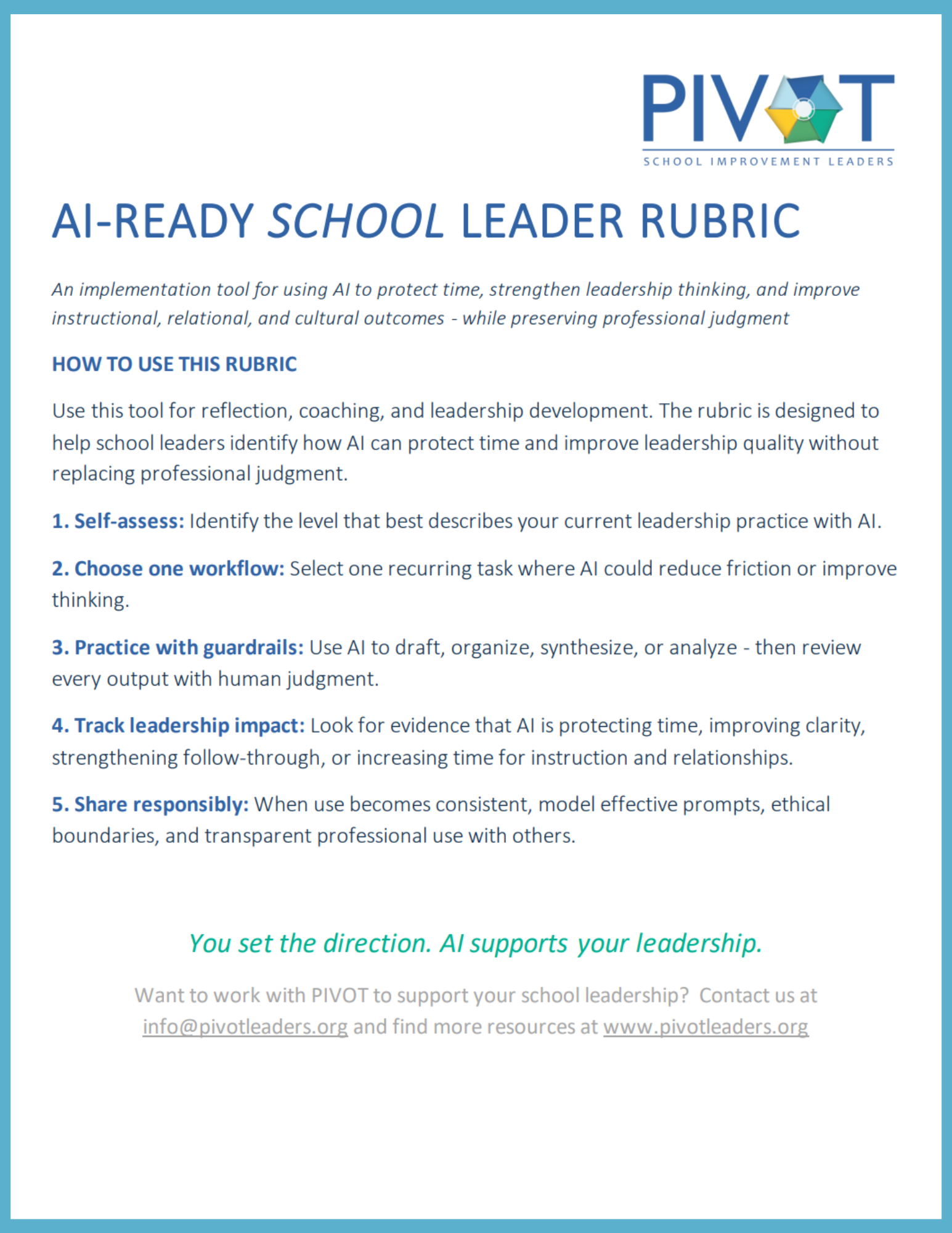
The AI-Ready School Leader Rubric
One of the anchor tools from the series was the AI-Ready School Leader Rubric. The rubric helps leaders reflect on their current level of AI readiness and identify concrete next steps for growth. It moves from early awareness to more integrated and transformational use, with attention to mindset, practice, leadership impact, typical behaviors, and growth focus.
The rubric is designed to help leaders and teams ask:
How are we currently using AI?
Are we using AI occasionally, or are we using it strategically?
Are we treating AI as a shortcut, or as a tool to strengthen leadership effectiveness?
Are we protecting human judgment, student learning, privacy, and trust?
What is our next step toward responsible and effective use?
The rubric is not intended to create pressure for leaders to become AI experts overnight. It is intended to give leaders a clear starting point for reflection, conversation, and action.
The Bigger Leadership Takeaway
AI-ready schools require AI-ready leaders. That does not mean leaders need to know every tool, trend, or technical detail. It means leaders need enough fluency to ask better questions, enough judgment to protect quality, enough clarity to create expectations, and enough courage to lead through uncertainty.
The most effective school leaders will not use AI to replace relationships, professional expertise, or instructional judgment. They will use AI to strengthen their capacity to lead.
They will use it to prepare more thoughtfully.
They will use it to communicate more clearly.
They will use it to analyze more carefully.
They will use it to design stronger supports for teachers and students.
And they will create the guardrails needed to ensure AI strengthens, rather than weakens, the work of schools. AI readiness is not about chasing the newest tool. It is about building the leadership capacity to use emerging tools responsibly, strategically, and in service of student learning.
Ready to Begin the Conversation?
The AI-Ready School Leader Rubric is a practical starting point for principals, district leaders, and leadership teams who want to better understand their current readiness and identify their next step.
Download the AI-Ready School Leader Rubric
If your school, district, or leadership team is ready to move from AI curiosity to responsible implementation, PIVOT School Improvement Leaders can help you build the clarity, confidence, and governance needed to lead this work well.