
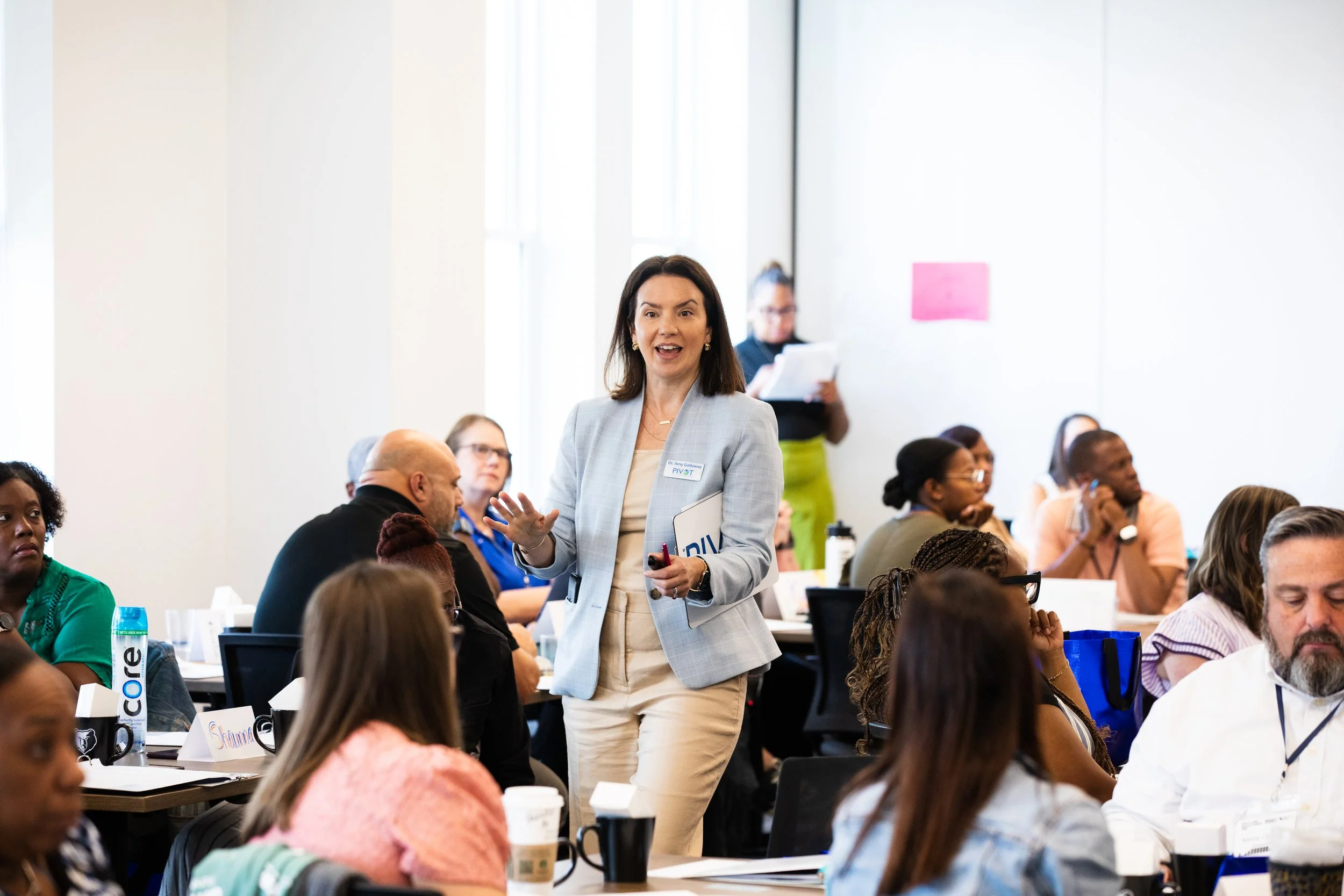
Dr. Amy Galloway, Executive Director of PIVOT: School Improvement Leaders, facilitating a session during the 2026 School Leader Summer Institute.
What We've Learned from Coaching Hundreds of School Leaders
Over the years, we've had the opportunity to work alongside school leaders in a wide range of contexts. Some lead small rural schools. Others lead large urban campuses. Some inherit strong teams and strong cultures. Others take on leadership in the midst of significant challenges.
Despite their differences, we are often struck by how difficult the work is for all of them.
The demands on today's school leaders are relentless. On any given day, a principal may move from a classroom observation to a parent meeting, from a staffing challenge to a student discipline issue, from instructional planning to operational problem-solving. The job requires leaders to navigate an endless stream of competing priorities, all while maintaining a clear vision for teaching, learning, and school culture.
And yet, some leaders consistently create more growth than others.
After coaching hundreds of school leaders, we've come to believe the difference is rarely intelligence, experience, charisma, or even effort.
What distinguishes them is the discipline with which they approach the work.
They are disciplined about where they focus their attention. Disciplined about how they spend their time. Disciplined about investing in people, building systems, and staying connected to teaching and learning.
While there is no single formula for improving a school, we've noticed five disciplines that appear repeatedly among leaders who create sustained improvement.
1. They Build Systems Instead of Depending on Heroics
One of the most common traps for school leaders is acting as though their value comes from being indispensable.
Schools are complex organizations. Every day presents new problems that demand attention. For many leaders, the default response is to work harder, stay later, answer one more email, solve one more problem, and carry one more responsibility. For a while, this can look like strong leadership. But eventually, heroics break down.
The leaders who create lasting improvement understand that their job is not to do the work themselves. Their job is to build systems that allow the work to happen consistently.
When they see communication breakdowns, they build communication systems. When they see inconsistent coaching, they build coaching systems. When they see gaps in instructional quality, they build systems for observation, feedback, and support.
These leaders think beyond today's problem. They ask, "What structure would prevent this problem from recurring?" The schools that improve the most are rarely powered by extraordinary individuals alone. They are powered by systems that make excellence repeatable.
2. They Are Relentlessly Focused on Teaching and Learning
The most successful school leaders never lose sight of why the school exists.
While their calendars are filled with operational demands, staffing issues, parent concerns, and compliance obligations, they remain deeply connected to the instructional core of the school.
They visit classrooms frequently. They look at student work. They engage in conversations about what students are learning and where students are struggling. They use evidence from classrooms and student work to guide decisions. Importantly, they don't treat instructional leadership as simply observing teachers. They understand that student work is often the clearest reflection of the quality of instruction happening across a school.
The strongest leaders we've worked with have an almost obsessive curiosity about student learning. They want to know what students can do, why they can do it, and what systems need to change when students are not yet succeeding. Their attention sends a powerful message throughout the organization: teaching and learning are the main thing.
And they keep the main thing the main thing.
3. They Invest in Relationships Before They Need Them
School improvement is fundamentally human work. New initiatives, strategic plans, and improvement efforts are only as effective as the people responsible for implementing them. The best leaders understand this reality and act accordingly. They do not build relationships only when they need support. They build relationships continuously.
They spend time listening. They seek to understand perspectives before offering solutions. They establish trust through consistency and follow-through. They invest in the small moments that accumulate into strong professional relationships. Over time, these investments create something invaluable: organizational trust.
When difficult conversations need to happen, trust helps people stay engaged. When change becomes necessary, trust helps people move forward together. When mistakes occur, trust creates space for learning rather than blame. The leaders who improve schools understand that relationships are not separate from the work. Relationships are the work.
4. They Develop Leaders, Not Followers
Many organizations become dependent on a single strong leader. The best schools do the opposite. The strongest leaders are constantly looking for opportunities to expand leadership in others.
They identify promising talent early. They create meaningful leadership opportunities. They coach emerging leaders through successes and failures. They delegate responsibilities that stretch people's skills rather than simply lighten their own workload.
These leaders understand that every conversation can be developmental. Every meeting can be an opportunity to build someone else's capacity. Every challenge can become a learning experience for another leader. As a result, leadership becomes distributed throughout the organization. When leadership is shared, schools become more sustainable. More innovative. More resilient.
Perhaps most importantly, students benefit from having stronger adults throughout the system, not just in the principal's office.
5. They Are Disciplined with Their Time
Many organizations become dependent on a single strong leader. The best schools do the opposite. The strongest leaders are constantly looking for opportunities to expand leadership in others.
They identify promising talent early. They create meaningful leadership opportunities. They coach emerging leaders through successes and failures. They delegate responsibilities that stretch people's skills rather than simply lighten their own workload.
These leaders understand that every conversation can be developmental. Every meeting can be an opportunity to build someone else's capacity. Every challenge can become a learning experience for another leader. As a result, leadership becomes distributed throughout the organization. When leadership is shared, schools become more sustainable. More innovative. More resilient.
Perhaps most importantly, students benefit from having stronger adults throughout the system, not just in the principal's office. If there is one characteristic we see repeatedly among highly effective leaders, it is intentionality.
The strongest leaders understand that every "yes" comes with a cost. They know they cannot pursue every initiative, attend every meeting, and respond to every request with equal urgency. Instead, they make deliberate choices about how they spend their time and attention.
They align their calendars with their priorities. They protect time to be in classrooms and PLCs. They create space for developing others. They carve out opportunities to reflect, learn, and think strategically.
Perhaps most importantly, they are willing to say no. In a field that faces endless demands, discipline often matters more than effort. Many leaders are working incredibly hard. The leaders who create lasting improvement are often the ones who have learned where their effort matters most.
The Common Thread
At first glance, these disciplines might appear unrelated. Systems. Instruction. Relationships. Leadership development. Time management.
But underneath them all is a common belief. The most effective leaders recognize that improvement does not happen by accident. It happens when leaders intentionally create the conditions for success.
They build systems that outlast them. They stay connected to teaching and learning. They invest deeply in people. They develop other leaders. They exercise discipline in how they spend their time and attention.
After coaching hundreds of school leaders, we've seen no single formula for school improvement.
But we have seen these disciplines emerge again and again among the leaders whose schools continue to grow long after the excitement of any particular initiative has faded.
And that's encouraging.
Because disciplines can be learned.
Which means better leadership, and better schools, are within reach.